Supreme Court Clarifies Scope of Section 9 Post-Award: Relief Available Even to Unsuccessful Parties
Updated: Sep 16
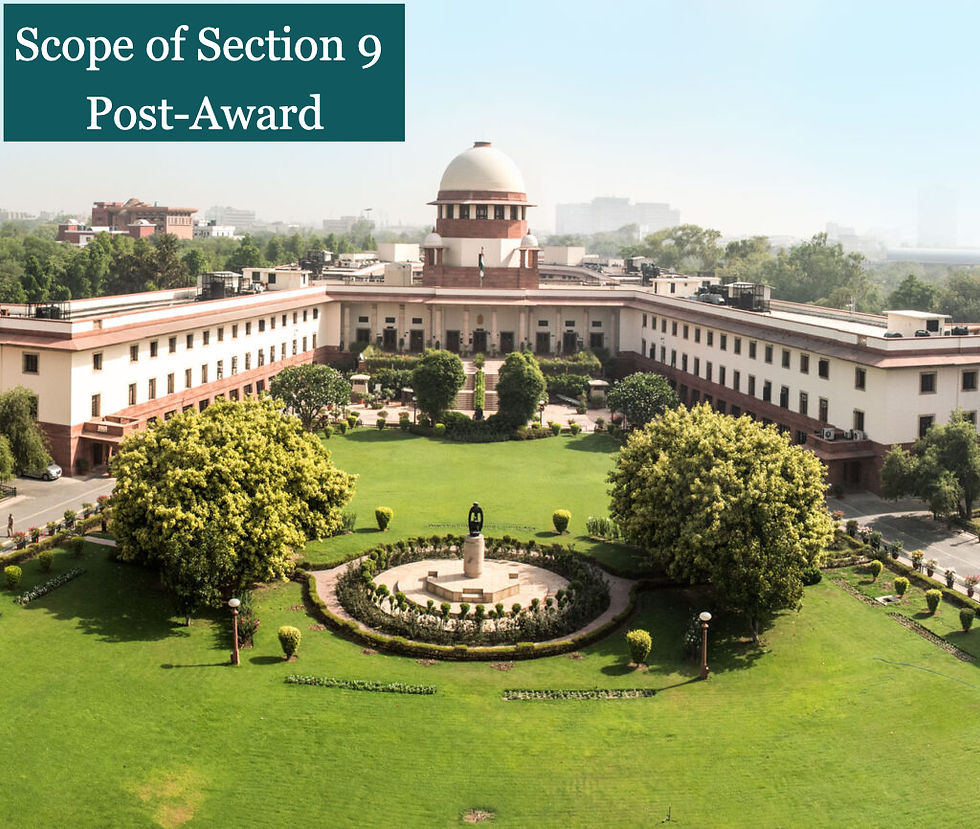
In a significant ruling that settles a long-standing judicial divergence, the Supreme Court in Home Care Retail Marts Pvt. Ltd. v. Haresh N. Sanghavi
(2026 SCC Online 670) has held that an unsuccessful party in arbitration may also seek interim relief under Section 9 of the Arbitration and Conciliation Act, 1996 (“Act”), even after the arbitral award has been rendered.
Issue
The core question before the Court was whether a party that has lost in Arbitration, and therefore holds no enforceable award, can maintain a petition under Section 9 of the Act at the post-award stage.
This issue had seen conflicting High Court views. While the Bombay, Delhi, Madras, and Karnataka High Courts had denied such relief to unsuccessful parties, the Telangana, Gujarat, and Punjab & Haryana High Courts had taken a more permissive view.
Decision
While deciding the issue, the Supreme Court adopted a plain-language interpretation of Section 9 of the Act and held that the expression “a party” under Section 9 of the Act includes any party to the arbitration agreement, without distinction between successful and unsuccessful parties. It was further held that the statute does not impose any limitation restricting post-award interim relief only to award-holders. The court observed that the Courts cannot read such a restriction into the provision, as doing so would amount to judicial legislation.
Short Analysis
1. Interpretation of the statute
The Court emphasized that Section 9 clearly permits interim relief to any party before, during, and after the award (but prior to enforcement), with no distinction based on the outcome of arbitration.
2. Purpose and objective of Section 9
The provision is intended to ensure that parties can seek protection of the subject matter of the dispute or amounts in issue until the judicial process is fully concluded, not merely to secure the “fruits of the award, giving it a broader purview”
3. Section 9 operates independently of:
o Section 34 (challenge to award), and
o Section 36 (stay of enforcement).
These provisions do not adequately protect the subject matter of the dispute, especially for a party challenging the award.
4. Evolving Jurisprudence
The Court noted that earlier judgments such as Dirk India Pvt. Ltd. v. Maharashtra State Electricity Generation Co. Ltd. 2013 SCC OnLine Bom 481 rested on the assumption that courts could only set aside or uphold awards. This premise is no longer valid in light of recent rulings permitting limited modification of awards.
5. Practical Considerations
The Court recognised scenarios where denying relief would cause injustice, such as:
risk of asset dissipation during a Section 34 challenge;
partial success in arbitration;
or cases involving fraud or pro
cedural irregularity.
While expanding the scope of Section 9, the Court clarified that:
Relief to unsuccessful parties should be granted sparingly and only in rare and compelling cases.
The threshold remains high, requiring a strong prima facie case, a balance of convenience, and risk of irreparable harm.
Conclusion
This judgment marks an important shift towards a more equitable and pragmatic interpretation of interim relief in arbitration. By allowing unsuccessful parties limited access to Section 9 remedies, the Supreme Court tries to ensure that the arbitral process remains fair and effective, particularly during the critical post-award, pre-enforcement stage.
The decision overrules restrictive High Court precedents and reinforces that statutory rights cannot be curtailed based on perceived outcomes of arbitral proceedings.
Junaid Aamir for Perennial Chambers
Scope of Section 9 Post-Award


Comments